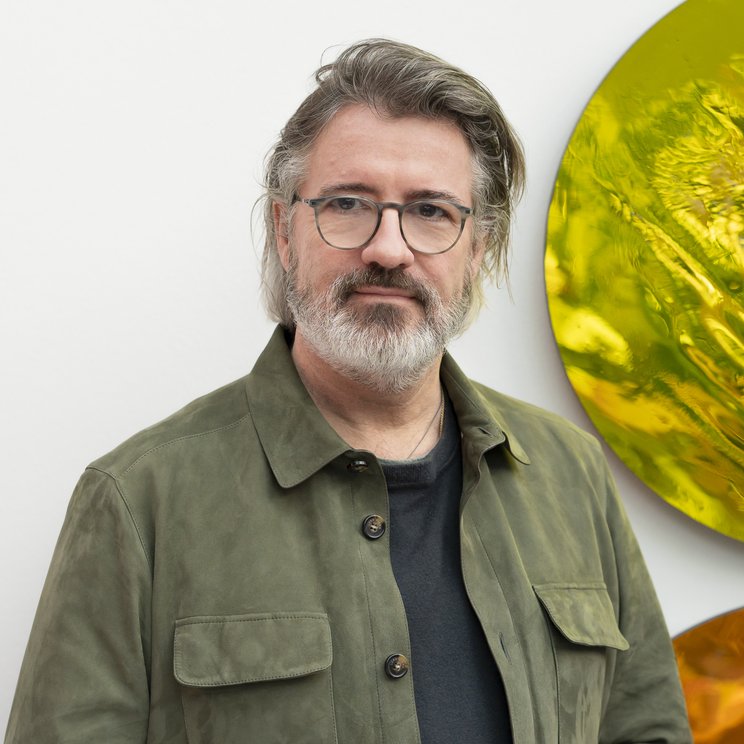
Olafur Eliasson
Vita
The artist Olafur Eliasson was born in Copenhagen in 1967 to Icelandic parents and studied at the Royal Danish Academy of Fine Arts from 1989 to 1995. He subsequently moved to Berlin, where he founded Studio Olafur Eliasson. The Studio brings together a large, interdisciplinary team drawn from architecture, art history, science, engineering, craftsmanship, and culinary practice. Eliasson’s work — encompassing installations, painting, sculpture, photography, and film — explores the role of art in the world, with a particular focus on nature, perception, and the environment. His practice frequently experiments with light, water, color, mist, and scent. His Weather Project installed an artificial sun in the Turbine Hall at Tate Modern in London in the winter of 2003-04, attracting more than two million visitors. For New York City Waterfalls (2008), he installed four large artificial waterfalls around the southern tip of Manhattan. In Ice Watch (2014), Eliasson transported 30 blocks of glacial ice from Greenland to urban spaces, allowing them to melt in order to draw attention to the effects of global warming. He has also designed the Fjordenhus at the harbor of Vejle, created the facade of the Harpa Concert Hall in Reykjavik, and, on the occasion of the 250th anniversary of Caspar David Friedrich’s birth, designed a new window for St. Nicholas Cathedral in Greifswald. In 2003, he represented Denmark at the 50th Venice Biennale. From 2009 to 2014, he served as a professor at the Institute for Spatial Experiments at Berlin University of the Arts. Eliasson is also committed to social causes, notably through the Little Sun project, which produces solar-powered LED lamps for people without access to electricity. In 2014, he co-founded Studio Other Spaces (SOS) with architect Sebastian Behmann. He was appointed a UNDP Goodwill Ambassador for climate action in 2019 and, in 2023, was awarded the Praemium Imperiale in recognition of his artistic engagement with the climate crisis.
February 2026